.svg)
Inventory rarely gets the attention it deserves—until a customer asks a question no one can answer.
For many movers, old-school inventory processes make questions about what was moved or what was damaged harder to answer than they should be.
Paper inventories, rushed notes, and scattered photos fall short when accountability, professionalism, and customer expectations matter most.
As more movers compete on experience—not just price—inventory stops being paperwork. It becomes part of the service.
And done right, it can set you apart.
This is where Descriptive Inventory comes in: an electronic, item-by-item inventory process that documents condition, exceptions, and verification throughout the job lifecycle—not just at pickup.
This helps movers deliver a more premium customer experience while protecting the business from fraudulent claims.
Inventory problems cost more than you realize
Inventory issues aren’t just operational challenges. They shape how customers perceive your company.
When inventory is unclear, customers feel uncertain.
When documentation is inconsistent, trust erodes.
When processes feel outdated, your credibility is questioned, especially on higher-end moves where expectations are higher and margins are larger.
This is especially true for movers handling:
- Van Line moves
- Military moves
- Corporate relocations
- High-value residential customers
In many of these cases, descriptive, electronic inventories are required—not optional.
Inventory breakdowns don’t just show up as claims.
They show up in quieter, more damaging ways:
- Wasted time and internal frustration
- Unhappy customers
- Negative reviews and strained referral relationships
When inventory is unclear, teams are forced to reconstruct the past instead of focusing on what comes next.
All of these problems point to one underlying issue.
The real problem? Consistency
Most crews document inventory in some way. The issue isn’t effort—it’s consistency.
Documentation varies from crew to crew and job to job. Details are captured differently. Damage descriptions lack standardization. Photos and notes live in different places. As jobs move through storage, warehouses, and multiple drivers, that inconsistency compounds.
The result?
Inventory that technically exists—but can’t reliably answer the questions customers care about:
- What was moved?
- What condition was it in?
- Who last handled it?
Why paper inventory no longer works
Paper inventories feel fast and familiar, which is why they’re still common. But in real-world conditions, they have clear limitations.
- Handwriting is hard to read
- Damage descriptions are vague
- Photos are missing or saved on personal phones
- Paper gets lost, damaged, or separated from the job
- Movers still work in the rain. Triplicate paper forms don’t hold up in those conditions.
When questions come up later, customers struggle to understand what was recorded. That works against your brand and comes across as unprofessional.
Digital inventory, on the other hand, provides a clear record that protects the mover and the customer.
The chaos of move day
Crews are under pressure to move fast. They’re loading trucks, managing customers, and watching the clock. Asking them to slow down and build a detailed inventory from scratch feels unrealistic—so compromises get made.
- Items are grouped together
- Notes are short and inconsistent
- Damage gets missed or documented vaguely
Inventory done this way doesn’t reflect the level of service the mover wants to deliver.
Inventory breaks down during storage and handoffs
When a move involves storage, multiple drivers, or warehouse handling, responsibility becomes harder to track.
Without structured inventory checks at each handoff, simple questions turn into back-and-forth conversations instead of clear answers.
For regulated moves like Van Line, military, or corporate relocation programs, this lack of structure creates compliance issues, not just operational headaches.
What Descriptive Inventory means for you
Descriptive Inventory is built to capture item-level documentation quickly and consistently on move day. It creates a clear, item-by-item record that follows the job from start to finish.
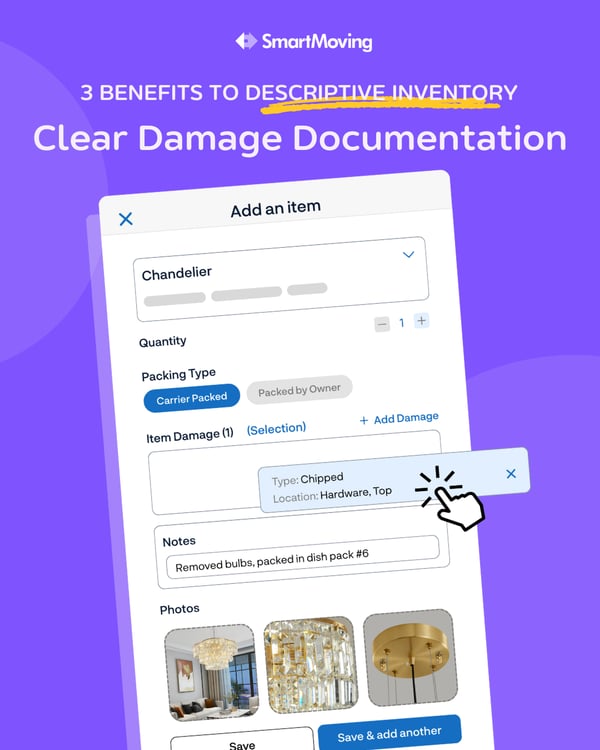
The SmartMoving Crew App lets crews capture detailed condition notes, exceptions, and photos for every item. Each item is uniquely identified, allowing inventory to be verified not just at pickup, but at key points throughout the move.
Every check is recorded and stored with the job.
This supports:
- Clear accountability across teams
- Consistent documentation across crews
- Van Line and military move compliance
- A more professional customer experience
Built for real-world movers
One of the biggest concerns movers have is that detailed inventory will slow crews down. SmartMoving’s Descriptive Inventory is designed for how move days actually run.
Crews can:
- Start inventory from scratch or import a pre-move inventory to get a head start
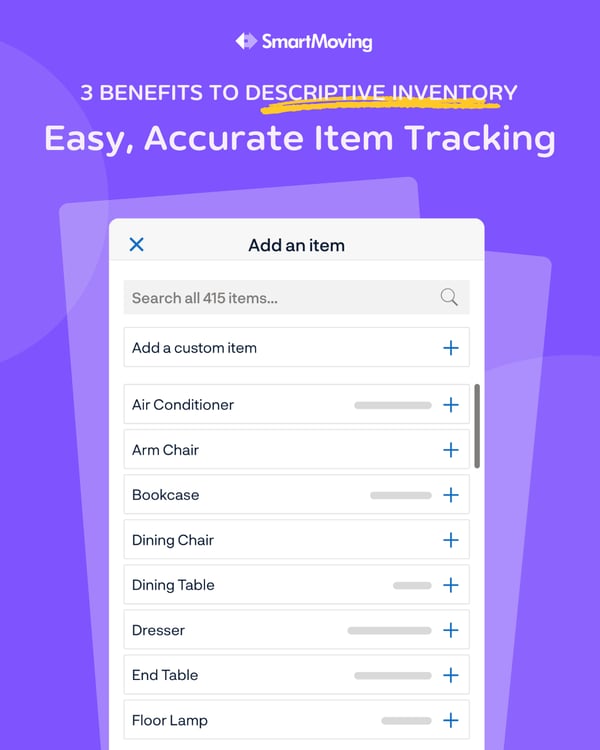
- Use Common Items to speed up entry
- Add multiple identical items and copy item details to maintain item-level accuracy
- Flag high-value items, including firearms
- Add photos and document damage quickly using exceptions
When inventory is accurate, consistent, and easy to complete on move day, it stops being just an operational requirement. It becomes the foundation for customer experience and post-move processes like claims resolution.
That’s where Descriptive Inventory delivers value well beyond move day.
Descriptive Inventory as a premium service
Some movers use Descriptive Inventory as a true differentiator in competitive markets. Instead of treating inventory as internal paperwork, they position it as part of a higher service standard.
Customers see that every item is documented clearly, reviewed together, and signed off in a professional way.
That experience helps:
- Justify higher pricing
- Reinforce attention to detail
- Support stronger reviews and referrals
- Elevate brand perception
The message shifts from “we move your stuff” to “we take responsibility for every item we handle.”

Descriptive Inventory for claims resolution
When a claim comes in, the full timeline is already documented.
You can see:
- What condition was recorded at pickup
- What changed during driver or warehouse checks
- What was noted at delivery
Photos and notes are tied directly to individual items, not buried in general comments.
SmartMoving also supports voiding items with a full audit trail and restore capability, so changes to inventory are always transparent and recoverable. This protects your team from disputes and ensures edits don’t create confusion.
Legitimate claims become easier to resolve. Questionable ones become easier to evaluate—without guesswork.
Final thoughts
Inventory is one of the most visible parts of a move—even if movers don’t always think of it that way.
A clear, descriptive inventory signals organization, transparency, and accountability. It supports Van Line and military moves and helps premium movers stand out in a crowded market.
Descriptive Inventory in SmartMoving turns inventory from something crews rush through into a premium customer experience customers notice—and remember.